Brown v Ridley [2025]

Brown v Ridley [2025] UKSC 7 is a landmark Supreme Court case that concerned a boundary dispute rooted in adverse possession. Mr Brown owned land in Consett, County Durham, while his neighbours the Ridleys owned the adjacent plot, Valley View. A previous owner of Valley View had erected a fence and hedge that inadvertently enclosed a strip of Mr Brown's registered land. The Ridleys used this disputed strip as part of their garden and later built a house on it, obtaining planning permission in 2018. When Mr Brown raised objections under the Party Wall Act in October 2019, the Ridleys responded by applying to the Land Registry in December 2019 to be registered as owners of the disputed land by adverse possession under the Land Registration Act 2002 (LRA).

The central legal question turned on paragraph 5(4)(c) of Schedule 6 to the LRA, which requires an adverse possessor, in boundary dispute cases, to have reasonably believed they owned the disputed land for at least ten years of the period of adverse possession ending on the date of the application. The Ridleys' reasonable belief had ended around February 2018, approximately 21 months before their application, meaning the ten years of reasonable belief did not run right up to the application date. The First-Tier Tribunal found in favour of the Ridleys, but the Upper Tribunal reversed that decision, reading the provision as requiring the ten years of reasonable belief to be the ten years immediately preceding the application.

The Supreme Court unanimously allowed the Ridleys' appeal. Lord Briggs, giving the sole judgment, held that the provision required only that there be any ten-year period of reasonable belief within the overall period of adverse possession, not necessarily the final ten years ending on the application date. The Court reasoned that requiring belief to subsist right up to the date of application would have the perverse effect of forcing adverse possessors to apply immediately upon losing that belief, which was both unrealistic and likely to inflame neighbour disputes.

The Court rejected Mr Brown's suggestion that a short de minimis grace period would solve this problem because it has no basis in the statutory language and sits awkwardly alongside the way grace periods are handled elsewhere in adverse possession legislation. The Court also dismissed the argument that human rights considerations under Article 1 of Protocol 1 of the ECHR required a narrower, less expropriatory interpretation, noting that the European Court of Human Rights had already held that even the more generous pre-LRA adverse possession regime was Convention-compliant. The Ridleys' application to be registered as owners of the disputed land was therefore permitted to proceed.

Back to blog
UOLLB SQE Turbocharge

UOLLB SQE Turbocharge

Get fully prepared for SQE1 without breaking the bank. Access cost-effective SQE study manuals and 2000 practice questions developed by UOLLB, edited by lawyers, and published by UOL Press.

Turbocharge SQE Performance
UOL Case Bank

UOL Case Bank

Upon joining, you become a valuable UOL student and gain access to over 2,200 essential case summaries. UOL Case Bank is approved by UOL School of Law and is constantly expanding. Speed up your revision with us now.

Subscribe Now

Join students and legal professionals from Legal 500 firms, top universities and international organisations who trust UOLLB

Council of Europe
Crown Prosecution Service
Ministry of Defence
Baker Mckenzie
Linklaters
Atsumi & Sakai
Yale University
UC Berkeley
University of Chicago
Columbia University
New York University
University of Michigan
INSEAD
University of London
University College London (UCL)
London School of Economics (LSE)
King’s College London (KCL)
Royal Holloway, University of London 
Birkbeck, University of London
SOAS, University of London
University of Manchester
University of Zurich
University of York
Brandeis University
University of Exeter
University of Sheffield
Boston University
University of Washington
University of Leeds
University of Law
University of Kent
University of Hull
University of Notre Dame
Cardiff University
Queen’s University Belfast
Arizona State University
McGill University
Toronto Metropolitan University
University of Hong Kong (HKU)
Hong Kong University of Science and Technology (HKUST)
University of Buckingham
Robert Gordon University
ESSEC Business School
University of Puerto Rico

  • Criminal Practice

    Diagrams and Charts

    Our carefully designed diagrams and charts will guide you through complex legal issues.

  • Criminal Law

    Clear and Succinct Definitions

    Key concepts are concisely defined to help you understand legal topics quickly.

  • Property Law

    Statutory Provisions

    Statutory provisions are provided side by side with legal concepts to help you swiftly locate the relevant legislation.

  • Public Law

    Case Summaries

    We have summarised important cases for you so that you don't need to read long and boring cases.

  • Evidence

    Rules and Exceptions

    Rules and exceptions are clearly listed so that you know when a rule applies and when it doesn't.

  • Company Law

    Terminology

    Legal terms and key concepts are explained at the beginning of each chapter to help you learn efficiently.

  • Case Law

    Case law is provided side by side with legal concepts so that you know how legal principles and precedents were established.
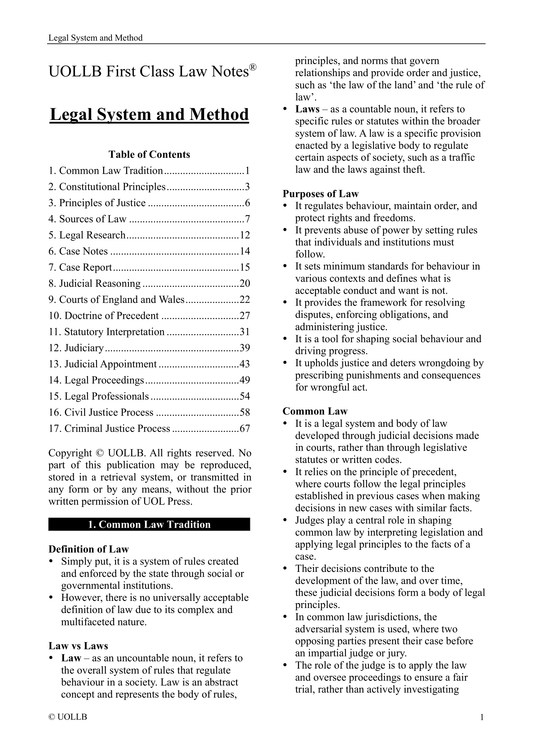
  • Law Exam Guide

    Law Essay Guide

    You will learn essential law exam skills and essay writing techniques that are not taught in class.
  • Law Exam Skills

    Problem Question Guide

    We will show you how to answer problem questions step by step to achieve first-class results.

  • Conflict of Laws

    Structured Explanations

    Complex legal concepts are broken down into concise and digestible bullet point explanations.

  • Legal System and Method

    Legal Research

    You will learn legal research techniques with our study guide and become a proficient legal researcher.

  • Jurisprudence and Legal Theory

    Exam-focused

    All essential concepts, principles, and case law are included so that you can answer exam questions quickly.