St Helens Metropolitan Borough Council v Derbyshire [2007]

St Helens Metropolitan Borough Council v Derbyshire [2007] UKHL 16 is a notable labour law case where the House of Lords considered the meaning of detriment in the context of victimisation and significantly developed the principles first articulated in Shamoon. The case is an important authority under discrimination law and continues to apply under the Equality Act 2010.

The claimants were a group of female employees who had brought equal pay claims against their employer, St Helens Metropolitan Borough Council. While those claims were ongoing, the council wrote a letter to the employees stating that the equal pay claims were causing serious financial difficulties for the council and might lead to cuts in services or job losses. Although the letter did not threaten the employees directly, it was clearly intended to discourage them from continuing with their claims.

The legal issue was whether sending the letter amounted to a detriment for the purposes of victimisation legislation. The council argued that the letter was merely informational and that the employees had not suffered any tangible loss or penalty as a result of receiving it.

The House of Lords rejected that argument. It held that the correct approach was to ask whether a reasonable worker might view the employer’s conduct as placing them at a disadvantage. Applying that test, the House of Lords concluded that a reasonable employee could regard the letter as exerting pressure, causing anxiety, and discouraging them from pursuing their legal rights. That was sufficient to amount to a detriment, even though there was no financial loss and no explicit threat.

The House of Lords emphasised that victimisation provisions must be interpreted purposively to ensure that workers are not deterred from enforcing their statutory rights. Employers are not permitted to subject employees to any form of pressure or adverse treatment because they have brought discrimination claims or supported others in doing so. Conduct that is intended to intimidate, dissuade, or penalise an employee for exercising those rights will readily satisfy the detriment requirement.

The ruling therefore confirms that detriment is a broad concept and includes psychological pressure, anxiety, or discouragement from pursuing legal claims. It builds on Shamoon by demonstrating that even subtle or indirect employer conduct can amount to a detriment if a reasonable worker would see it as disadvantageous. This case is frequently relied upon in Equality Act 2010 victimisation claims, particularly where an employer’s actions are aimed at deterring or punishing employees for engaging in protected acts.

Back to blog
UOLLB SQE Turbocharge

UOLLB SQE Turbocharge

Get fully prepared for SQE1 without breaking the bank. Access cost-effective SQE1 Study Guides and SQE1 Mock Exam developed by UOLLB, edited by lawyers, and published by UOL Press. Free downloads and resources available.

Turbocharge SQE Performance
UOL Case Bank

UOL Case Bank

Upon joining, you become a valuable member of our UOL Community and gain access to over 2,200 essential case summaries. UOL Case Bank is constantly expanding. Speed up your revision with us now.

Subscribe Now

Join students and legal professionals from Legal 500 firms, top universities and international organisations who trust UOLLB

Council of Europe
Crown Prosecution Service
Ministry of Defence
National Health Service (NHS)
Baker Mckenzie
Linklaters
Atsumi & Sakai
Yale University
UC Berkeley
University of Chicago
Columbia University
New York University
University of Michigan
INSEAD
University of London
University College London (UCL)
London School of Economics (LSE)
King’s College London (KCL)
Royal Holloway, University of London 
Birkbeck, University of London
SOAS, University of London
University of Manchester
University of Zurich
University of York
Brandeis University
University of Exeter
University of Sheffield
Boston University
University of Washington
University of Leeds
University of Law
University of Kent
University of Hull
University of Notre Dame
Cardiff University
Queen’s University Belfast
Arizona State University
McGill University
Toronto Metropolitan University
University of Hong Kong (HKU)
Hong Kong University of Science and Technology (HKUST)
University of Buckingham
Robert Gordon University
ESSEC Business School
University of Puerto Rico
University of Portsmouth

  • Criminal Practice

    Diagrams and Charts

    Our carefully designed diagrams and charts will guide you through complex legal issues.

  • Criminal Law

    Clear and Succinct Definitions

    Key concepts are concisely defined to help you understand legal topics quickly.

  • Property Law

    Statutory Provisions

    Statutory provisions are provided side by side with legal concepts to help you swiftly locate the relevant legislation.

  • Public Law

    Case Summaries

    We have summarised important cases for you so that you don't need to read long and boring cases.

  • Evidence

    Rules and Exceptions

    Rules and exceptions are clearly listed so that you know when a rule applies and when it doesn't.

  • Company Law

    Terminology

    Legal terms and key concepts are explained at the beginning of each chapter to help you learn efficiently.

  • Case Law

    Case law is provided side by side with legal concepts so that you know how legal principles and precedents were established.

  • Law Exam Guide

    Law Essay Guide

    You will learn essential law exam skills and essay writing techniques that are not taught in class.

  • Law Exam Skills

    Problem Question Guide

    We will show you how to answer problem questions step by step to achieve first-class results.
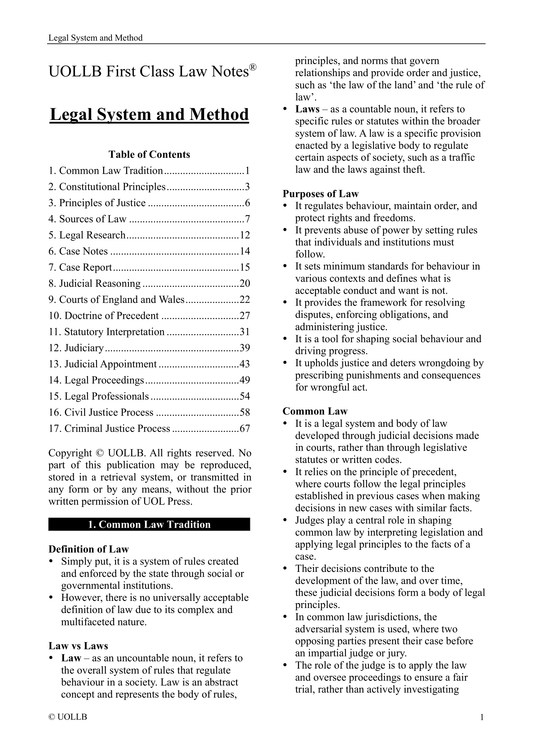
  • Conflict of Laws

    Structured Explanations

    Complex legal concepts are broken down into concise and digestible bullet point explanations.
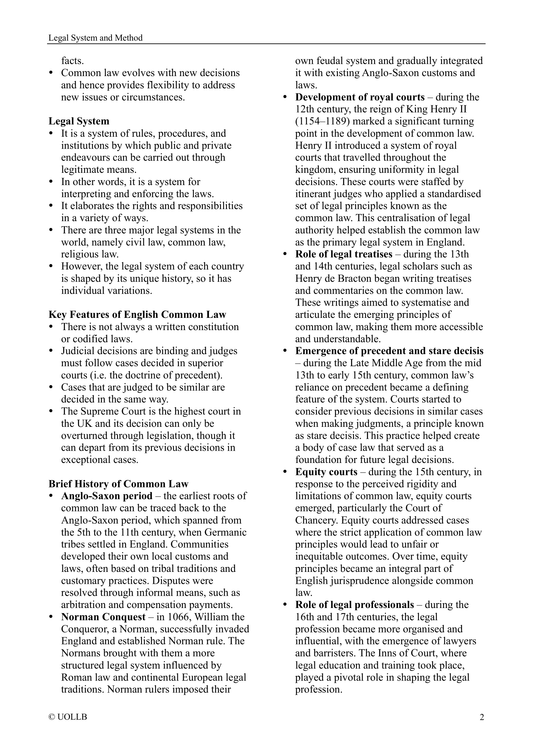
  • Legal System and Method

    Legal Research

    You will learn legal research techniques with our study guide and become a proficient legal researcher.
  • Jurisprudence and Legal Theory

    Exam-focused

    All essential concepts, principles, and case law are included so that you can answer exam questions quickly.