Top 10 English Contract Law Cases
Share
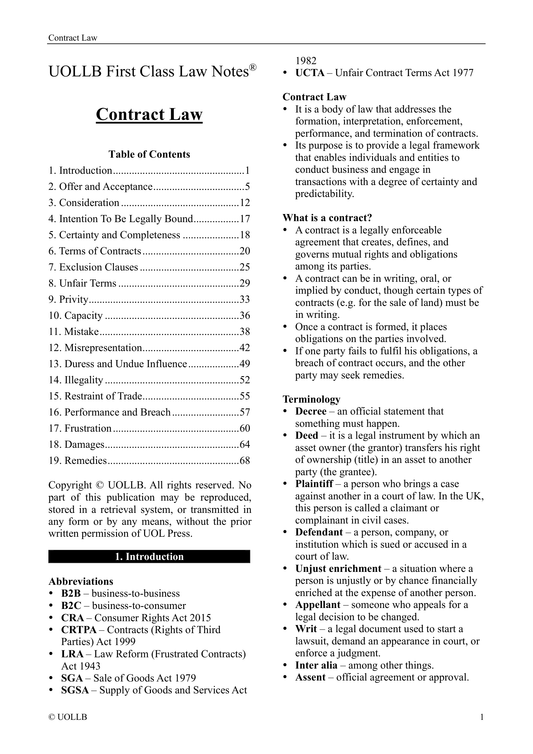
English contract law governs legally binding agreements and determines the rights and obligations of the parties involved. Over the centuries, courts have developed important principles concerning offer and acceptance, consideration, intention to create legal relations, contractual terms and remedies for breach of contract.
We have selected top 10 landmark cases that have shaped English contract law. These cases remain important authorities for understanding the formation, interpretation and enforcement of contractual agreements.
1. Carlill v Carbolic Smoke Ball Co (1893)
Carlill v Carbolic Smoke Ball Co established that a unilateral offer can be accepted through the performance of specified conditions without the need for separate notification of acceptance.
The case concerned a company that advertised a reward of £100 to anyone who contracted influenza after using its smoke ball in accordance with the instructions. The company claimed that the advertisement was merely promotional and did not constitute a binding offer. The Court of Appeal disagreed, holding that the advertisement amounted to a unilateral offer to the world, which Mrs Carlill had accepted by performing its conditions. The case remains a leading authority on unilateral contracts and offer and acceptance.
2. Balfour v Balfour (1919)
Balfour v Balfour established that domestic agreements between spouses are generally presumed not to create legally binding obligations.
The case concerned a husband who promised to pay his wife a monthly allowance while he worked abroad. When the payments stopped, the wife sought to enforce the promise. The Court of Appeal held that the agreement was not legally enforceable because the parties did not intend to create legal relations. The decision established an important distinction between domestic arrangements and commercial agreements.
3. Merritt v Merritt (1970)
Merritt v Merritt established that agreements between separated spouses can create legally binding obligations where there is an intention to create legal relations.
The case concerned a husband who agreed to transfer the family home to his wife once she had paid off the outstanding mortgage. The agreement was made after the couple had separated. When the husband refused to transfer the property, the wife sought to enforce the agreement. The Court of Appeal held that the agreement was binding because the circumstances demonstrated an intention to create legal relations. The case distinguished domestic arrangements made during marriage from agreements made after separation.
4. Central London Property Trust Ltd v High Trees House Ltd (1947)
Central London Property Trust Ltd v High Trees House Ltd established the modern doctrine of promissory estoppel.
The case concerned a landlord who agreed to accept reduced rent from a tenant during the Second World War because the property was only partially occupied. When the property became fully occupied again, the landlord sought to recover the full rent. Denning J held that the landlord could resume charging the full rent from that point. However, the judgment established that a party may be prevented from going back on a clear promise where the other party has relied on it. The case became a leading authority on promissory estoppel.
5. Hadley v Baxendale (1854)
Hadley v Baxendale established the rules governing remoteness of damage in contractual claims.
The case concerned a mill owner whose mill remained closed because a carrier delayed delivering a replacement crankshaft. The mill owner claimed lost profits resulting from the delay. The court held that contractual damages are recoverable only where the loss arises naturally from the breach or was reasonably within the parties' contemplation when the contract was made. The decision remains the leading authority on remoteness of contractual damages.
6. Pinnel's Case (1602)
Pinnel's Case established that part-payment of an existing debt is generally insufficient consideration for a promise to discharge the entire debt.
The case concerned a debtor who paid part of an outstanding debt before the agreed payment date. The creditor subsequently attempted to recover the remaining balance. The court held that payment of a lesser sum on the due date does not normally satisfy the entire debt. However, providing something different, such as earlier payment or payment at a different place, may amount to sufficient consideration. The principle was subsequently confirmed by the House of Lords in Foakes v Beer (1884).
7. Foakes v Beer (1884)
Foakes v Beer confirmed that a creditor's promise to accept part-payment of an existing debt does not normally prevent the creditor from recovering the remaining balance.
The case concerned an agreement under which a debtor would pay an outstanding judgment debt by instalments. The creditor agreed not to take further enforcement action, but later claimed interest on the unpaid balance. The House of Lords held that the debtor had provided no fresh consideration for the creditor's promise to waive the interest. The decision reaffirmed the rule in Pinnel's Case.
8. Hyde v Wrench (1840)
Hyde v Wrench established that a counter-offer terminates the original offer, meaning it can no longer be accepted.
The case concerned a landowner who offered to sell his farm for £1,000. The prospective buyer responded with an offer of £950, which the seller rejected. The buyer subsequently attempted to accept the original offer of £1,000. The court held that the counter-offer had terminated the original offer, so no binding contract had been formed. The case remains a leading authority on counter-offers and acceptance.
9. Williams v Roffey Bros & Nicholls (Contractors) Ltd (1991)
Williams v Roffey Bros & Nicholls (Contractors) Ltd established that a practical benefit obtained by a promisor may constitute sufficient consideration for a promise to pay additional money.
The case concerned a contractor who promised a subcontractor additional payment to ensure that building work was completed on time. The contractor obtained practical benefits from the arrangement, including avoiding delay penalties and the cost of finding a replacement subcontractor. The Court of Appeal held that these benefits could amount to sufficient consideration for the additional payment. The decision developed the law on consideration in existing contractual obligations.
10. Entores Ltd v Miles Far East Corporation (1955)
Entores Ltd v Miles Far East Corporation established that acceptance communicated through instantaneous methods takes effect when it is received by the offeror.
The case concerned a contract formed through telex communications between parties in different countries. The court had to determine where and when the contract was concluded. The Court of Appeal held that acceptance by instantaneous communication is effective when received by the offeror, rather than when it is sent. The decision remains an important authority on acceptance and the formation of contracts through electronic communications.